
Subtotal $0.00



Quick Overview
This guide explains what makes Kathak footwork challenging for beginners, from coordinating tatkaar with rhythm and posture to maintaining balance and control. You’ll learn about common practice mistakes, how to approach slow and fast footwork, the role of bols and riyaaz, and the signs that your technique is progressing. It also explains when structured guidance can help you develop stronger and more consistent footwork.
Introduction
If you’ve recently started learning Kathak, you may find that the footwork feels harder than it looks. Tatkaar, the foundation of Kathak footwork, requires coordination between rhythm, posture, balance and movement. In this guide, we’ll explore why beginners struggle with tatkaar, common mistakes to avoid, and practical ways to improve your technique.
What Is Tatkaar in Kathak?
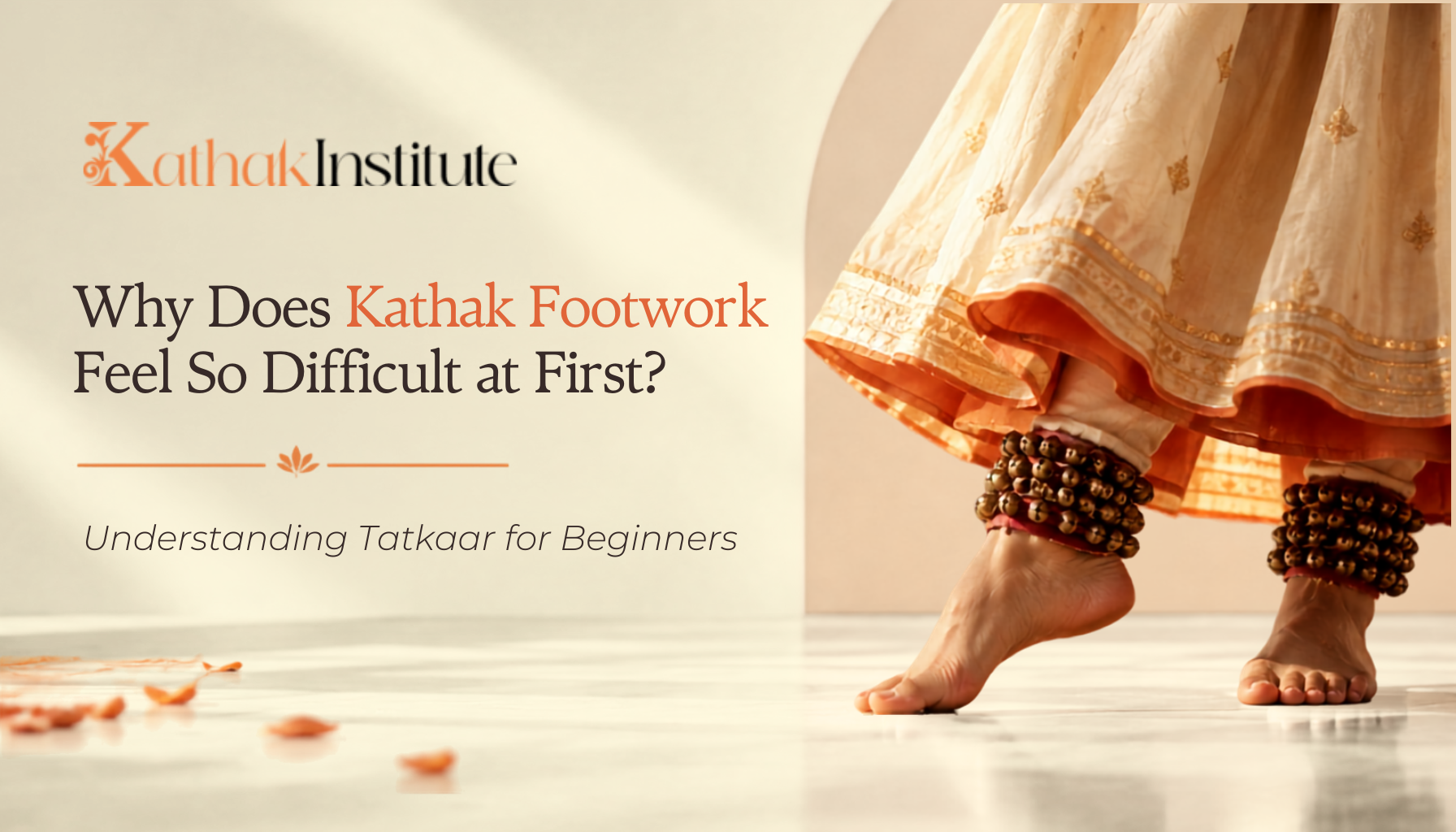
Tatkaar is the basic rhythmic footwork of Kathak. It involves producing controlled rhythmic patterns with the feet while maintaining the characteristic posture and movement quality of the dance.
The difficulty is that tatkaar is not simply about moving your feet quickly. Your foot movements need to stay connected to rhythm, laya, posture, weight distribution and coordination.
Kathak also uses spoken rhythmic syllables, or bols, as part of its learning process. Reciting the rhythm before physically performing it can help students understand the pattern before asking the body to reproduce it.
That is why a pattern that looks easy when demonstrated by an experienced dancer can feel completely different when you try it yourself.
Why Does Kathak Footwork Feel So Difficult for Beginners?
There are several reasons. Most are not signs that you are “bad at dance”. They are simply part of developing a new physical and rhythmic skill.
1. Your Brain Is Learning Rhythm and Movement at the Same Time
When you are new to Kathak, you are not only remembering steps. You are also learning where those steps belong within a rhythmic cycle.
Your brain may understand the pattern while your feet struggle to reproduce it.
This is one reason beginners sometimes say:
“I know the steps, but my feet don’t do them.”
The solution is usually not to practise faster. Slow practice gives your brain more time to connect the rhythm with the movement.
Research and instructional material on tatkaar consistently emphasise the importance of coordination, rhythmic clarity and gradual progression rather than simply increasing speed.
2. Your Upper Body Has to Stay Controlled While Your Feet Are Active
Another common challenge is keeping the upper body steady.
Beginners often concentrate so intensely on their feet that the shoulders rise, the torso moves from side to side, or the body leans forward.
This happens because your body is trying to help with a movement that your feet have not yet learned to perform automatically.
Instead of forcing your upper body to remain completely rigid, aim for stability with relaxation. Your posture should support the footwork rather than fight against it.
3. You May Be Trying to Increase Speed Too Soon
Fast footwork looks impressive, so it is natural to want to reach faster tempos quickly.
However, speed can hide technical problems.
If the footwork is unclear at a slower tempo, increasing the speed usually makes the same problem harder to control. Kathak training resources commonly recommend developing precision and clarity before increasing tempo.
A useful principle for beginners is:
Accuracy first. Speed later.
Your goal should not be to complete as many repetitions as possible. It should be to make each repetition more controlled.
4. Your Feet Are Developing New Muscle Memory
Kathak asks your feet to produce precise sounds while your body maintains posture and your mind stays connected to rhythm.
That is a lot of information to process.
With repeated, correct practice, movements gradually become more automatic. Students discussing tatkaar practice often describe difficulty maintaining the movement as the tempo increases, particularly when trying to coordinate the physical action with the beat.
This is why consistency matters more than occasional, exhausting practice sessions.
What Are the Most Common Tatkaar Mistakes Beginners Make?
Understanding the problem is often the first step towards correcting it.
Mistake 1: Stamping Instead of Controlling the Foot
Loud footwork does not automatically mean good footwork.
A beginner may try to create a stronger sound by using excessive force. This can create unnecessary tension and make it harder to maintain rhythm.
Focus on clarity and control rather than volume.
The aim is for the foot to meet the floor with intention and rhythmic accuracy.
Mistake 2: Looking Down at Your Feet
When you are learning a new pattern, it can feel natural to watch your feet.
But repeatedly looking down can affect your posture and concentration.
Try to develop awareness of where your feet are without constantly checking them visually. A mirror can be useful during practice because it allows you to observe your overall posture while keeping your gaze appropriately placed.
Mistake 3: Moving the Shoulders With Every Step
If your shoulders bounce or your torso shifts with every foot strike, your body may be using unnecessary movement to compensate for unfamiliar footwork.
Practise the foot pattern slowly while paying attention to what happens above the waist.
Ask yourself:
- Are my shoulders relaxed?
- Is my spine upright?
- Am I leaning forward?
- Am I holding my breath?
- Can I keep my upper body relatively stable while my feet work?
These observations can reveal problems that are difficult to notice when you are concentrating only on your feet.
Mistake 4: Practising Only When You Feel Confident
Beginners sometimes avoid tatkaar because it feels repetitive or difficult.
But foundational practice is supposed to feel challenging before it becomes natural.
Regular, focused riyaaz helps build familiarity with the rhythm and movement. Even a short practice session can be useful when the quality of practice is high.
Mistake 5: Copying Speed Instead of Technique
Watching an advanced dancer perform rapid footwork can be motivating, but copying their speed as a beginner can create frustration.
An experienced dancer has already developed the coordination that makes that speed possible.
Instead of asking, “How can I do this faster?”, ask:
“Can I do this clearly and comfortably at my current level?”
That question will lead to better long-term progress.
How Can Beginners Improve Kathak Footwork?
Improving tatkaar does not require endless repetition without direction. Your practice should have a purpose.
Start Slowly
Choose a tempo at which you can maintain:
- Correct posture
- Clear foot placement
- Consistent rhythm
- Relaxed shoulders
- Controlled movement
Once those elements become reliable, gradually increase the tempo.
Recite the Bols
If you are learning a rhythmic pattern, saying the bols aloud before dancing can help you understand its structure.
This is where padhant, the recitation of rhythmic syllables, becomes valuable. In Kathak, rhythmic patterns can be spoken before being executed through footwork and movement.
Instead of immediately trying to make your feet remember everything, allow your voice and mind to understand the rhythm first.
Practise One Element at a Time
If you are struggling with everything simultaneously, simplify the exercise.
For example, focus on:
- Understanding the rhythm.
- Reciting the bols.
- Performing the foot pattern slowly.
- Checking your posture.
- Gradually increasing the tempo.
This approach makes it easier to identify exactly where you are losing control.
Record Yourself Occasionally
A short recording can reveal things you may not notice while dancing.
You might discover that:
- Your shoulders move more than expected.
- Your posture changes as you get faster.
- One foot sounds different from the other.
- Your timing becomes uneven towards the end.
- You are concentrating so hard that your movement becomes tense.
Use recordings as a learning tool rather than as a way to judge yourself.
How Much Should a Beginner Practise Tatkaar?
There is no single number of minutes that is right for every student.
Your practice time depends on your current level, overall training schedule, physical comfort and what your teacher has assigned.
For a beginner, consistent and attentive practice is generally more useful than pushing through long sessions while becoming increasingly tired or tense.
If your footwork starts becoming less controlled, your posture deteriorates or you are repeatedly making the same mistake, taking a break can be more productive than simply continuing.
Your teacher can also help determine how much practice is appropriate for your individual stage of training.
When Should You Move From Basic Tatkaar to Faster Footwork?
There is no universal deadline.
A student may be ready to progress when they can perform the foundational pattern with reasonable consistency while maintaining posture, rhythm and control.
Your teacher may then introduce variations in tempo or more complex rhythmic material according to your level.
Trying to progress simply because another student is moving faster can be counterproductive. Kathak is a progressive discipline, and students develop coordination at different rates.
If you are unsure about your current level, structured guidance can make the learning process clearer. Learn more about Dr. Soniya Sharma’s Kathak expertise and teaching approach before beginning your training.
Can You Improve Kathak Footwork Through Online Classes?
Yes, structured online learning can be useful for developing foundational Kathak skills, particularly when classes provide clear demonstrations, guided practice and teacher feedback.
However, online learning works best when students actively participate in the correction process. Your camera position, practice space and ability to follow instructions can all affect how clearly your teacher can observe your technique.
You can also use the Institute’s Kathak classes videos as a useful visual reference alongside your structured learning.
Seeing experienced dancers perform can help you understand the relationship between footwork, posture, rhythm and overall movement quality.
How Do You Know If Your Tatkaar Is Improving?
Progress does not always mean being able to dance faster.
Look for smaller changes:
- Your rhythm feels less confusing.
- You can remember the pattern without constantly thinking about each foot.
- Your upper body stays more stable.
- Your foot sounds become more consistent.
- You recover more easily when you make a mistake.
- You can maintain the pattern for longer without unnecessary tension.
- You feel more comfortable listening to the rhythm while dancing.
These are meaningful signs of developing coordination.
You can also observe how experienced students apply their foundations by exploring the Institute’s Kathak dance classes gallery.
What If My Feet Still Feel Awkward After Practising?
Don’t assume that difficulty means you are not progressing.
Kathak requires a combination of physical coordination, musical understanding and disciplined repetition. Beginners may understand a movement intellectually before their bodies can execute it consistently.
If you keep encountering the same issue, however, this is a good reason to seek feedback rather than simply repeating the movement hundreds of times.
A teacher may be able to identify a small technical adjustment that is difficult to recognise on your own.
If you’re ready to build your foundation with structured guidance,
you can begin your Kathak learning journey with the Beginner course.

Frequently Asked Questions About Kathak Footwork
Is tatkaar difficult for beginners?
Tatkaar can feel difficult because beginners are learning rhythm, foot coordination, posture and balance simultaneously. The movement itself may look simple, but performing it consistently requires practice and control.
How can I improve my tatkaar in Kathak?
Start with a comfortable tempo and prioritise clear, controlled footwork. Recite the bols, maintain good posture and increase speed gradually as your technique becomes more consistent.
Why do my shoulders move when I do tatkaar?
Your shoulders may move because your body is compensating for unfamiliar footwork or excessive tension. Slow down and focus on keeping the upper body relaxed and stable while allowing the feet to work independently.
Should beginners practise Kathak footwork every day?
Regular practice can help develop coordination and muscle memory, but the ideal frequency depends on your training level and individual circumstances. Consistency and correct technique are more important than simply practising for long periods.
Should I learn fast tatkaar as a beginner?
It is generally better to develop accuracy and control at a manageable tempo before increasing speed. Fast footwork becomes more useful when the underlying technique is already stable.
Final Thoughts
Tatkaar can feel difficult at first because Kathak asks your body and mind to learn several things at once. Your feet need to follow rhythm, your posture needs to remain controlled, and your movements need to become increasingly precise.
That process takes time.
Instead of measuring your progress only by speed, pay attention to clarity, rhythm, balance, coordination and control. A slow, accurate practice session can contribute more to your development than a fast session filled with tension and repeated mistakes.
With patient guidance and consistent riyaaz, the footwork that once felt unfamiliar can gradually become one of the most natural parts of your Kathak practice.
If you’re ready to start learning Kathak from the foundations,contact Kathak Institute to begin your Beginner course.


Comments are closed